
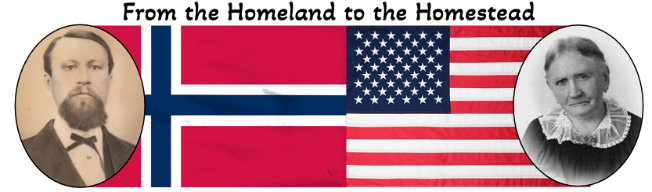

We have included a family history that was written by Jim Eitrheim for the 100 year celebration held at the farm in 1974. In 2024 we will be celebrating the 150th anniversary of Anna and Thorstens journey to their new homestead in South Dakota. Jim’s story is a great read and we are fortunate to have captured these stories that can be shared with future generations. As time passes we all have less personal knowledge of our ancestors and we hope by sharing these stories it may stir interest within your families to spend a day with us in July meeting relatives and touring the area where it all began.
ONE HUNDRED YEARS OF THE OLD HOMESTEAD

We have a family history that was written by Jim Eitrheim, a grandson of Anna and Thorsten, for the 100 year Anniversary of their homesteading. The 100 Year Farm is a rare account of our family’s story.
ONE HUNDRED YEARS OF THE OLD HOMESTEAD
1 8 7 4 – 1 9 7 4
James Eitrheim
The Centennial History of The Thompson Homestead
CHAPTER I: Beginnings
The story contained in these pages is woven from the stuff of real life and therefore the events mentioned need no embellishment to be dramatic. As this is a history, it contains the record of both joy and sorrow, triumph and defeat, hardship and celebration. It is the history of a farm, a plot of ground, but of greater significance, it is the history of the family that 100 years ago this summer chose to make their home here.
The Bounding Main
Most stories cannot just begin; They require a background for the leading characters that places them at the scene. We must seek the origins of our story during the American Civil War in another country. It was 1864 when Ivor and Ingeborg Opdahl boarded a sailing vessel bound for America. They were leaving their meager life on the island of Tysnes, close to Bergen, Norway, with high hopes that they could acquire their share of the storied wealth of the new land.
Certainly they were aware of some of the hardships to come, as relatives already settled in America had often written to them. They must have been somewhat nervous about moving to a country then engaged in civil war. But their greatest fears were put aside by the promise of the “Homestead Act” which would give the settler 160 acres of land just for living on it. What Norwegian accustomed to ten-acre plots could resist such a temptation?
The Opdahls brought their four children, Kari, Ragnild, Ole, and Anna with them. Anna celebrated her tenth birthday onboard the Maria, a small but new sailing ship. She was to be a hard luck ship, as after one week at sea, she had the mainmast broken off in a storm, drifted for a week and then was towed into England by a steam ship to make repairs. A few days after setting out the second time, the ship struck a partially submerged wreck and broke open some seams.
Men would have to work four pumps day and night to keep her afloat for the rest of the voyage. They were becalmed for eleven days, and the 365 passengers on board ran out of food and water. Rainwater was caught in barrels and some food was procured from a passing Dutch ship. The crew also shared their hard tack, but they were in pathetic condition when they anchored in the St. Lawrence River off Quebec. They hoisted a distress flag and food was brought out to them. During the voyage one child died and one child was born. It was fourteen weeks since they had left Norway.
The New-Comers
The immigrants were loaded into freight cars (courtesy of Uncle Sam), transported to Montreal, and from there they proceeded by lake steamer to Milwaukee, Wisconsin. The first years were spent with an uncle of Ingeborg’s on his farm in Freeborn County, Minnesota, and it was from this area south of Albert Lee that Anna and Thorsten Thompson were to come by covered wagon some years later.
The first years must have been very hard as they tried to learn the language and earn a bare living while staying with relatives. He was fourteen years old when Thorsten Thompson also came to this country in 1864. He was fourteen years old at the time, and we must assume that his crossing was less eventful than grandmother’s.
Thorsten and his brother Knute decided that the family name Onarheim would be too difficult in the new land and changed it to Thompson. As work was very hard to find, Thorsten held a variety of jobs. One winter he went to work in the north woods as a lumberjack and in the spring helped float the logs downstream to the saw mill. He also found work for a short time in a brick yard in Rochester, Minnesota.
Thorsten and Anna Thompson were married in Freeborn County and decided to homestead land in the newly opened Dakota Territory. One hundred and sixty acres would be theirs if they lived on it and improved it for two years. They were encouraged in this venture by Knute, Thorsten’s brother, who had gone west the previous year and established a claim in Minnehaha County, Lyons Township, Dakota Territory.
Where the Buffalo Roamed
It was July 2, 1874 , when Thorsten and Anna arrived in Sioux Falls. They had been on the way for two weeks in a covered wagon pulled by two horses. All of their worldly possessions were in that wagon or trailing behind it in the form of livestock. In the wagon was a cook stove, a homemade table and chairs, and, of course, Grandmother’ s spinning wheel. The wagon top was made by Grandmother out of material they had purchased for that purpose. Their live stock consisted of a few cows, two sheep, the team pulling the wagon, and two black colts called Frank and Prince. Those two colts lived to be twenty years of age and certainly did much of the hard work involved with making a farm out of a wilderness.
They camped that night on Penitentiary Hill overlooking the city of Sioux Falls. What they saw could not have been too impressive. A fort for protection against the Indians still stood at the present location of the Hollywood Theatre. Most of the storefronts were frame and the few houses were equally unimpressive. It was a busy place, however, as it had been several years since the last Indian uprising and homesteaders were flocking in to claim land. The city was not pretty, but it had eight lawyers, three doctors, two resident ministers, twenty carpenters, five masons, two blacksmith shops, two meat markets, six general stores, one barber shop, one livery stable, and two machinery dealers. By the time of her death in 1948, Grandmother couldn’t get over what had happened to Sioux Falls. It had grown to a city of more than 50,000 inhabitants. She shook her head in amazement at the changes she had seen.
On July 3, 1874, Anna Thompson first set foot on this land. She was twenty years of age and carried her five -week-old son, Tom, in her arms. The task ahead was awesome and this place must have seemed to be the end of the world. There were no trees in sight, as only the Sioux River valley was blessed with trees. The tall prairie grass made cross country travel very difficult, and the “roads” were winding wagon tracks. The closest neighbors were out of sight and the only sound was the relentless blowing of the sea of tall grass.
Their first home was part dugout and part sod hut. The roof was made of tree branches, then a layer of straw, then more branches, and finally a layer of sod. The thick sod walls, the small door and smaller window probably made a fairly warm shelter, but it still was like living in a cave. It was their home for four years and was located a bit east of the place where Bill has his silage pits. Those first years must have required great courage. It was particularly hard on the women, as they faced not only hard work but loneliness.
The Sea of Grass
The size of the untamed prairie would have intimidated most people. Taking the wrong turn when the wagon track forked could lead to real tragedy as there were no road maps and very few landmarks. Rolvaag in Giants in the Earth discusses the relief that Per Hansa felt when he saw Split Rock Creek, as he was afraid that he had somehow taken the wrong turn. There has been some difficulty in marking battle sites, etc., because even the cavalry had trouble retracing their steps. When the renegade Ink-Pa-Duda and his band were tracked down and killed soon after the Spirit Lake massacre, the army was unable to mark the site. It was not until they were expanding the runways at the airport with WPA labor in the 1930’s that the shallow graves were discovered. Army reports had been so vague that the site could have been anywhere in a fifty -mile area.
The rolling landscape and the limitless horizons were not so different from the open sea to a sailor. No sea-faring man could become lost if he could see the stars and therefore open spaces held little terror for him. Could this be the reason why so many of the original pioneers on the prairie were Scandinavian fishermen?
The emptiness and the solitude was a problem in itself, but the grass was certainly a real problem. It was taller than a man’s head at times and so tangled that it made travel cross country on foot very difficult. The old trails worn by migrating buffalo and other animals became the first roads. Some of the trails were made by the Indians as they seemed to have favorite camping areas. One such trail leads from Yankton to Pipestone, Minnesota, as the Indians returned often to make their ceremonial pipes.The remains of that trail can still be seen on the campus of Sioux Falls College [now, The University of Sioux Falls].
The early settlers lived in great fear of prairie fires. These blazes could be started by lightning or combustion and, if driven by a wind, could advance at speeds up to sixty miles per hour. All of the pioneers were advised to protect their claims by plowing fire breaks. Usually the farmer would plow two furrows at least six feet apart and then on a still day would carefully burn off the strip between the two furrows. Repeating this process several times would result in a wide strip of fire break. A strong wind could drive a fire across such a barrier, but they had other weapons. Starting backfires which would burn toward the blaze would eat up its fuel and give some further protection. If the fire reached your fire break, however, the only thing to do was to fight it with wet burlap sacks and all the courage you could muster.
On one such occasion a prairie fire came upon this place from the west and threatened to destroy everything. Anna had been in bed with an attack of pleurisy [inflammation of the lining of the throat membranes and thorax.] and was hardly able to move about. However their very lives were threatened and she grabbed a wet sack and fought the fire, smoke, and heat with might and muster. When it was all over and they had saved the homestead, Grandmother felt fine: Is it any wonder that she believed that “hard work was the best medicine?
Breaking up the sod so that crops could be planted proved to be a hard task, as the walking plow and a team of horses were not up to the size of the problem. It would not be many years before implements had wheels and a rider’s seat, but all the farms in this area were broken up the hard way. The lines to the horses were knotted and placed behind the man’s shoulders or neck; both of his hands grasped the plow handles, and, as the team lunged forward, the man used all of his strength to hold the plow in the ground, going in a straight line. The pioneers called this ‘breaking’. It could be argued that the man was more broken than the soil. It must have taken years before the entire farm was in production.
If the grass was a curse, it was also a blessing. There was no woodpile next to the house on the prairie as there were no trees. Some settlers used buffalo chips for fuel, but they were not present in a lasting supply. The grass itself made adequate fuel and it was certainly abundant. It had to be tightly twisted and tied into a little bundle, however, if it was to burn slowly. Twisting hay was a time-consuming and boring task, but it was necessary for years, until the trees provided wood or corn cobs replaced it as a fuel. It was probably some years before people could afford to buy coal and to purchase a “hard coal heater”.
The Grasshopper Plague
In 1874 Thorsten had managed to break up quite a plot of ground. A good garden must have been growing, as we can remember Grandmother’ s energy. It was about noon in mid-August, just before the harvest, when the mid -day sun began to darken. It was not the smoke of prairie fires this time or a sudden storm cloud. This was a living cloud of insects in such numbers that they covered everything. The grasshoppers had arrived, as they would every year with varying intensity. 1874 was the worst of the plagues. The devastation was so complete that it appeared “as though a prairie fire had swept the area. There were no leaves on the trees, no prairie grass, and no vegetable gardens left. Grandpa was distressed because his experiment with raising tobacco had been wiped out and he had to smoke charred wheat that winter. It must have been awesome to be
stranded in the wilderness, their seed grain gone and not even enough food to get them back to safety. Their courage and even their good humor never faltered, however, and the story of a German settler’s fight to save his garden brought much laughter. When the grasshoppers began to eat his garden, the German took the quilts off the beds and spread them over the plants while he chased them with broom and spade. When the air cleared, he had lost both his garden and his bedding. As he looked at the ruin, he said, “Der vus only von onion left, unt on dat onion vus a big grasshopper eating avay mit tears in his eyes.”
A group of businessmen in Sioux Falls went east and raised $500 for a relief fund so that the settlers could stay on the land that winter, but many would have left over the years had it not been for the efforts of a single man. C. K. Howard ran a large grocery store which had, in previous years, been a trading post dealing mostly in furs. He was “blunt, uncouth”* and used terrible language, but he had faith in people and in the area. He sent them back to their claims with food and clothing on credit. His expletives did not endear him to Grandmother, but she allowed that he was a good man at heart. C. K. Howard died penniless, but the pioneers erected a thirty foot monument in his memory which still stands in Woodlawn cemetery. This history includes his name only because the Thompsons and many others might have had to leave the area had it not been for his generosity.
As a footnote to the grasshopper plagues, it should be pointed out that no one has ever given a satisfactory answer to the questions of where did the grasshoppers come from, where did they go to, and could they ever reappear? The breaking up of the sod may have destroyed their breeding grounds, but, if undisturbed grassland is all they needed, the regions to the west still supply that in abundance. The last infestation was in the 1930s, but it was not very damaging.
The Blizzard of 1888
The fall of 1887 had been most pleasant. One sunny day had followed the other and now it was January l2th, 1888. There was about two feet of snow on the ground due to heavy recent accumulations. At about 3:15 that afternoon the storm struck with terrifying violence and swiftness. Some witnesses described the sound of the storm as that of an approaching train. Within seconds the loose snow had reduced visibility to nothing. The force of the wind and snow made breathing difficult and the temperature began to drop sharply. Anna and Thorsten managed to get all of the children into the house with the exception of the oldest son, Tom, who was pumping water for the cattle south of the buildings. This fourteen-year-old boy probably had less than a quarter of a mile to the buildings, but the intensity of the storm was so great that he did not dare to leave the well.
Thorsten and Anna rescued him by following a fence south as far as they could and then attracted the boy’s attention by shouting and beating on a dishpan that Grandmother had brought along. That they had saved Tom ‘s life by prompt action was apparent when the reports of the storm were complete. Many people perished only a few feet from their homes. Winds estimated at sixty to seventy miles per hour whipped the loose snow around until it was impossible to see at all, but the sudden drop in temperature, reported as low as forty degrees below zero, was the element that took lives. The whole storm lasted only ten hours. Certainly the winters of 1881, 1936, 1949, and 1969 were much colder, had much more snow, or were much longer, but no one who lived through that one violent night in 1888 ever forgot it. A plaque at Lone Tree honors a school teacher who saved the lives of all the children in her one-room school house that night by her heroic action, and Anna Hildah ‘s account of the storm in the centennial history of Nidaros Congregation indicates that the reaction to the storm was universal.
Nearer My God to Thee
The pioneers were for the most part intensely religious. Certainly their precarious hold on their claim, their first -hand acquaintance with death, and their closeness to nature contributed to their deep personal faith. Grandmother often said that the Twenty-third Psalm had gotten her through many difficult times. With such strong convictions, it is not surprising that even before her own family was secure, her thoughts turned to the possibility of building a church. The Nidaros congregation was already well established, but it was miles away and it was necessary to cross the Sioux River. That was a terrible barrier during the spring thaw and at times of heavy rain. In 1875 Anna and Thorsten became charter members of the Willow Creek Lutheran Church. Only thirteen people were named on the first charter, but they managed to erect a building in 1888 that cost $3,500. Grandmother was instrumental in raising money. With characteristic determination she shouldered her quilting frames and walked several miles to make patchwork quilts and other saleable items to be sold at bazaars. Even the name of the church reflects her influence. She and Thorsten had attended Lime Creek Lutheran Church at Emmons, Minnesota, prior to coming to the prairie. She was president of the ladies aid for thirty years, and was certainly a main force in all the programs of the church. Her oldest daughter, Rachel, was the first child to be baptized in that Congregation.
It was originally proposed that the church building would be located on the corner just east of this farm, and, with that in mind, a graveyard was established and trees planted. When the site was changed, most of the graves were moved, but several graves remain, including that of the third child, Edwin, who died in infancy in 1878. When I was growing up, two lone cottonwood trees marked that site, but they were removed when the road was re-graded in the 1950’s.
Grandmother was very kind, but not noted for her tact. On one occasion a man came to church directly from the barn, and Grandmother sent him home to clean up. She could not abide dirt, but often said that patches were no disgrace. Being poor was a condition which she could understand, but poverty did not excuse dirt, as that could only indicate laziness.
At the 75th anniversary of the church Anna Thompson had her say. She told of the pioneers and of their struggle for survival in the early years. She was to bring a short greeting, but Anna Thompson had many years and much wisdom to impart. Despite her ninety -plus years, she stood with dignity and held that large audience in rapt attention. She was the only surviving charter member at that time. She and Thorsten are buried in the cemetery at Willow Creek, as are three of their children.
A Time for Laughter
Anyone reading this history so far would assume that hard work and tragedy were the only things that have occurred on this farm. Not so! Good times and laughter were also a large part of everyday life and the pioneer was the original optimist. People got together often in both their work and play. In that sense they had a feeling of community that we could strive to attain. If by our standards their amusements seem a bit dull or primitive, we should see them in light of that age and not through our sophistication.
The bleakness of the winter was offset by sleigh rides complete with bells on the horses and straw in the two-horse bob. The horse drawn bobsled was a necessity and all the farmers had one for chores and transportation. A few families had cutters pulled by a single horse, but they did tend to tip over easily and they had a more limited use. Parties at homes may have included taffy pulling, apple ducking, or ring games. The church became the social center of the community with its chicken dinners, lutefisk dinners, and meetings of various church related organizations. Bazaars to raise funds were at least a yearly event, and they were well attended. People would come for miles to any social event.
The Christmas season was always a joyous occasion. The decorations were homemade but attractive. Cranberries and popcorn strung together, a few candles and some apples would decorate the Christmas tree. The presents were practical and often homemade. Grandmother was a whiz at knitting even in her old age. She said that before her fingers were so stiff, she could knit a pair of socks after the children had gone to bed. I can imagine that socks, mittens, and scarves were often found under the tree. The special foods served at Christmas time were lutefisk, lefse, flot brod and roome grot. Oranges and rock candy were considered unusual enough to be given as gifts. Almost every Christmas season saw the revival of a strange custom called “Christmas Fooling”. A group of masked and ridiculously dressed neighbors would present themselves at the door making as much noise as possible. They were invited in and there was much hilarity at guessing their identity and unmasking the guests. Christmas caroling from farm to farm was also a regular part of the season, and all participants ended the evening with much rock candy to reward their efforts.
Community Celebrations
For a number of years an old Settlers’ Picnic was held in John Thompson ‘s pasture along the Sioux River. Anyone could attend, but members of the group had to be on their claims prior to 1880. The fifth annual picnic was held on June 25 and 26 , 1896. Twelve hundred people attended the first day and two thousand came for the second day. A merry-go-round was the chief activity for both young and old, and, of course, there was much speech- -making and good food. This event was held at the Thompson ‘s pasture every year until 193, and the last picnic was held in 1939 in Elmwood Park. That crowd was very small as most of the original settlers were gone.
The park in Baltic has been the scene of many community gatherings. At least once a year the Nidaros congregations used to gather their four churches for morning services, then a picnic, then a ball game, then more speeches, and then an ice cream social in the evening. The Tronder Lage also had a yearly picnic in the park with much Norwegian speaking and singing. One year there were even boat rides on the river above the dam. On Labor Day the whole community gathered at the Royal Berg home for another all-day celebration. The Willow Creek Church sponsored this gathering and it had the usual speeches and solos but it also featured such diversities as hog -calling and a fat man’s race. Certainly the list is incomplete as I have not mentioned the Fourth of July or the Firemen’s picnic, but, rather than mention all of them, it might be more profitable to state that all of this activity did not happen without the concerted effort of many people and their desire to be of service. It would be nice to recapture that feeling of close -knit community in our large cities.
The Bells Are Ringing
This farm has been the site of some pretty big celebrations over the years. In June 1905, Annie Thompson was married to a neighbor boy, Alfred Fossum. They held the ceremony at the Willow Creek Church and then returned to the farm for the reception. A large lumber platform had been built south of the house for the purpose of holding a dance. Everything went well until it began to rain and the floor turned slippery. Rasmus Moller came to the rescue and spread ashes on the floor. This solved the problem,but many of the long dresses were ruined by the wet ashes. When Edwin was married to Annie Brevik in December, 1905, there had also been a dance. This one was held in the driveway of the “new” granary. There does not appear to be enough room in that driveway for a very big dance as I look at it now, but at least it was dry.
A Golden Wedding
Anna and Thorsten Thompson celebrated a golden wedding in 1923. It must have been a big celebration indeed. Tom, the oldest son, brought a big tent along from the Beloit Children’s Home where he was the superintendent. They got the tent up all right, but decided to put in a lumber floor. Henry Thompson took the Model T pickup and his nephew Richard and drove into the Baltic Lumber Yard. They must have gotten a bit too much lumber on the truck as the front wheels kept leaving the ground. When they came to the Hilmoe hill, Henry had to turn the truck around and back up the hill to prevent disaster. Five car loads of relatives came from Emmons, Minnesota, for the occasion. David Opdahl had two flat tires on the road and delayed the progress of the group. A 200-mile trip in those days was not so usual and several of the Opdahl women had children under one year of age with them.
A Ninetieth Birthday
Perhaps the biggest celebration held on this farm was in honor of Anna Thompson’s ninetieth birthday. She was not only the matriarch of this family, but seemed to enjoy that status in the whole community. She had out-lived her generation and now was the lone representative of the covered wagon pioneers. Over 200 relatives and friends came to celebrate her birthday on June 19, 1944. Grandmother had enjoyed very good health most of her life and, although she was a little hard of hearing and needed glasses to read, her memory for facts and people was unimpaired. She was showered with flowers and gifts of all kinds and displayed five birthday cakes. We were entertained at the event by the singing of the three Baalson girls, the Willow Creek Orchestra, several speeches, and a soft ball game in Harold Alvine’s pasture. It was truly Grandmother’ s day and she enjoyed it tremendously. She was remarkable for her spirit and perseverance as she never walked without effort after she broke her hip, but she seldom complained about anything.
She had seen the wilderness tamed and a civilization formed. She often remarked at her good fortune to have witnessed so much in her lifetime. Thorsten Thompson passed away at seventy -six years of age in 1927. Selma, the next to the youngest child, married Dan Eitrheim in 1927, and he purchased the farm for $90.00 an acre. Grandmother continued to live on the homestead until her death in March of 1948 at age ninety-three.
CHAPTER II
Much More About Much Less
Straw Sheds
During the 1930’s and 1940’s I saw my Dad build straw sheds and never thought much about them until I started to research this paper. Somehow I had never wondered what the early settlers did with their livestock in the first years on the prairie. I knew that granaries were often built of lumber while the settlers themselves lived in dug-outs or sod huts, but that is easily understood. The storage of grain would not be possible unless it could be kept absolutely dry. The first barns on these farms were straw sheds and they had a lot of merits. They were inexpensive, took little carpentry skill, and were warm and dry. A double row of posts formed the perimeter walls. Boards or netting were nailed to the posts and the space between filled with straw. The roof was of long poles, then branches, then great mounds of straw to drain the water off. They are very probably the ancestor of the modern pole shed which is now considered the best type of farm construction. It had perhaps one big advantage. If the manure got too deep, you could burn it and move to a new location.
The Flivver
I don’t know who had the first automobile on the place or its type, but in 1919 Selma–who had seldom ridden in a car much less driven one –decided that she would enter a contest, selling subscriptions for a Sioux Falls newspaper. Her brother Henry and her sister Nora helped and behold: Selma won a brand new Buick: It was the center of attention in the community for some weeks, and Nora and Selma learned to drive with little or no instruction. There was little danger of hitting anything as traffic was non-existent, and there were no ditches to go into as none of the roads were graded. The road past the farm was not graded until 1938 and it had no gravel until 1943. We have learned to take much for granted, and good roads are at the top of that list.
Woodman, Spare That Tree
The prairie pioneers had an understandable desire to plant trees. Certainly the large groves of trees remaining on all the neighboring farms are a testament to that common urge. The government also made it profitable to plant trees as one could claim additional land by putting in trees. Several plots of ground in our community were claimed in that fashion and a few of those tree lots can still be seen. Thorsten and Anna were enthusiastic tree planters and at one time a large grove of fruit trees stood in the area east of the houses. Only one of the original trees remains. The Chinese elms and some fruit trees were added in about 1942, but the outstanding feature of the place are the towering cottonwood trees along the road. They are a small remnant of the total grove of cottonwood trees that died in the 1930’s. They were certainly planted before the turn of the century and some of them have trunks of amazing girth. After so many years on the treeless plains it is not peculiar that we could not burn any piles of branches or dead trees when Grandmother was around. She had twisted a lot of hay for fuel and the sight of all that wood being wasted was more than she could stand. Such piles were usually burned when Grandmother was visiting the neighbors or in town. She thought the wasting of wood was “sinful” and often would get ahold of one of us boys to help pick up sticks for the stove. Gathering bushel baskets of twigs was not our idea of fun, but we reluctantly picked up the sticks she pointed out with her cane.
Down Hill!
Most of the Thompson children attended the Hilmoe School house which stood about two miles south and east of the farm. That school was organized around 1880 and grew to have sixty students and teachers. During the early years, there were many newcomer boys in their early twenties who attended during the winter to learn some basic English. They were very difficult for the teacher to control and at times the school board had to be called in to maintain order. On one occasion the entire school, under the leadership of some of these boys, decided to dismiss the school and go sledding. They took a two-horse bobsled to the top of a long and steep hill, and loaded most of the students in the box. Tollef was, of course, the tallest, therefore the one to steer, because the pole extended back over the open box. They had a terrific ride as you can imagine.
All went well until the sled dropped into a ravine and stopped short. The kids in the box were shaken but unhurt, but there was no sign of Toleff. The pole had acted like a Roman catapult, and Toleff had been propelled head first into a large snow drift and knocked cold. There was no lasting damage , but his brother Henry recalled the event with real relish.
Over There!
James Thompson had joined the army during the First World War as did his younger brother Henry. James was not big on letter writing so the family did not know where he was stationed. Henry, who joined the army later, was shipped to France just at the end of the war. While taking a stroll one day in Coblenz, Germany, Henry met his brother James on the street. Neither knew that the other was in Europe and James did not know that Henry was even in the army. That was a chance meeting!
Threshing
If we were to look at Bill’s combine, we could marvel at the size and complexity of that machine and the work it can accomplish in a day. The day of the threshing machine and the threshing run is gone, ended for good by the likes of that super- efficient combine. While the passing of the threshing machine is mourned only in a romantic and sentimental way, not in a practical way, threshing always has had a certain aura about it. Maybe it was the horses and stories of run-aways; perhaps it was the large crew of men and the camaraderie involved in working together; or it could be the now faded image of the lumbering steam engine. Whatever or whenever it was, it does conjure up in my mind the meals that were involved:I can easily see again platters of steak or chicken or roast beef, the mounds of mashed potatoes and gravy and great wedges of apple pie; the forenoon lunch with cake and sandwiches; the afternoon lunch with more of the same but add soda pop. Those were the days small boys could dream of all year long.
CHAPTER III
The New Breed
In retrospect it seems that the little house on the prairie should not have been subjected to a second generation of rowdy children, but should have been placed under a glass dome and had a citation pinned on its door for courage and durability. It did, however, serve again, while the four Eitrheims were growing up. The stair treads became so worn that they had to be replaced and there were occasional coats of paper and paint but for the most part the old house remained untouched until 1950.
An Electrifying Experience
In the 1930′ s Dan Eitrheim had his friend Knute Brendsel wire the house and put a 32-volt generator and batteries in the cellar. It was a good system and worked well for years. Dan did have to replace all the batteries once as the oldest son Norman climbed up on the shelf and tipped them all onto the floor, while reaching for some pears that hung from the ceiling. Those were glass jar batteries and Norm, who was splashed with battery acid, got a quick bath and a firm hand.
There was an old pump in the kitchen that brought cistern water directly into the house, but the rest of the plumbing was never added. The out -house still stands. The old cook stove had a water tank on its back and that delivered by a short piped warm water to the sink. In the mid-forties Dad bought an oil stove to replace the old soft coal heater. That was a new world. Imagine awakening to a warm house and not having water freeze if you left it in a glass overnight. Today people spend a lot of money on camping gear just to get the primitive feeling that we got everyday for nothing. The 1930’s saw real changes in farming methods. One day a big truck pulled into the place and began unloading a new F20 Farmall tractor. It was a thing of beauty, but we had some mixed emotions about it when the same truck backed down to the barn and began to load up the horses. Dad had traded the biggest and best horses he had for that tractor, and that was the end of an era. He did keep one team around for years, as he regarded them as a necessity while planting corn. The names of the horses still ring in my ears–Nig and Nelly – Noble and Dewey – Dolly and Babe – Frank – Daisy — Prince. Each horse had its own personality and its own stall-mate and a given measure of oats depending on how hard it was working. Erling Haugo allowed the Eitrheim boys to keep a pony of his for several years. Patsy was all of three feet high, but you learned to treat her with respect as she was known to bite, strike, and kick. Norm and Patsy went flying across the country, and at times Norm would fly alone into the ditch as one of Patsy’s best tricks was stopping short.
A Boy’ s Life on the Prairie
I have noticed that children’s games are not always centered around toys or ready-made games. Children will find amusement in the things that are available. In some ways the things we did growing up on the farm are not so different from present amusements, but some of them are gone forever. In the spring the instinct of the hunter is likely to rise with the sap in the trees and many a boy on this place has gone in pursuit of the wiley striped gopher. No expensive gun or ammunition was required, but the sport did require good muscles for water carrying. One shrill whistle would bring a gopher to the surface out of curiosity. Now the rush was on: Water sloshing out of the buckets, we would race to mark the hole.
There were one bucket and two bucket holes, but usually the wet gopher would emerge and head for a drier hole close by. The large sticks we all carried came into play as we swatted at the gopher, usually missing, and sometimes putting a knot on another boy’s shin. If the gopher did escape, it meant a long walk to the creek to refill the buckets. Dad would have been delighted if we had moved half that much water for thirsty calves or pigs. We did get a few gophers but mostly we got tired.
The trapping of pocket gophers was an economic necessity. Not to Dad but to his Boys. The morning trap line was the country boy’s paper route. The county paid a dime bounty for each pair of front claws and Dad, who was interested in getting rid of the pests, also paid a dime. (As I remember, Dad paid for some of Seymour Berven’s gophers.) Twenty cents per gopher was a fortune and we were very energetic in setting traps. When I took the claws to the courthouse for the bounty, I did notice that the secretary with manicured and polished nails used a pencil to pick through the pile of grisly claws that I placed on her counter. But she did not get as upset by half as the secretary over in Register of Deeds upon whose counter I once mistakenly emptied my sack of claws.
For those who would like to take up the trapping of gophers, here are some rules to follow:
1. Don’t dig with your hands as the gopher will smell you. Use your mother’s biggest and best mixing spoon.
2. Your dad’s license plates are the best thing to cover the open hole. Try to find old ones.
3. Do not hold the trap by the jaws when you place it in the hole. Your fingers smart for days if you do.
If one should like a little more adventure and really big money, few pastimes can equal the pursuit of skunks. I can think of no more exciting Sunday afternoon than one spent digging out a skunk den. A good den will contain several skunks, has several holes, and is usually spotted because of its sizable mound of clay. The hole can go many feet deep, but when the skunks begin to come out, any red-blooded American boy would say it was worth the effort. That level of excitement reaches peaks that could only be attained on an African safari. There were times when our welcome home from such festivities was a bit strained and We were asked to change clothing in the summer kitchen. One skunk hide was worth from three to five dollars. Midas should have been as wealthy.
Norm developed a method of capturing skunks alive by popping them into a sack. It was a sort of art to get the skunks ‘ tails down before they got you. If the skunk was quicker than Norm was quick, Norm could be socially unacceptable for days. Even after washing with strong soap and using gobs of shaving lotion, there was a certain gaminess about him. His skill was undeniable, however, as we once had one adult skunk and 5 or 6 of their offspring in a cage. As Norm says: “We could pick up the offspring by their tails without them becoming impolite.”
School Days
All of the Eitrheim children were educated in the one -room schoolhouse one half mile west. At the time everyone knew that it was antiquated and would have to be replaced by a bigger and better school system. It seems strange that thirty years later people in the large universities now look back on such a system as something to be sought after in terms of “social structuring.” I think that all that needs to be said is that if we had a good teacher, we learned a lot! A recitation bench was placed in front of the teacher’s desk, and it was there that you were given the individual help necessary to do the work. You were sent back to your own desk with an assigned task and the next group approached the recitation bench. Blackboard work was done in front of the whole school while the others were supposed to be working on their own assigned task. Our hot lunch program was a matter of placing our jars of soup, etc. on a large floor radiator. On a few occasions someone forgot to loosen the cover on the jar and it exploded. Then we picked noodles off the blackboard and the smell of burning soup was with us for days.
Even in this “ideal social structure, ” some were more successful than others. Recess was my favorite subject. I excelled at Kick The Can, hide and seek, fox and geese, skinning the cat on the rings, bicycling, and roller skating in the basement. (The roller skating must have driven the teacher up the wall.) We also played a game called “long ball.” I can’t think that the name suits the game well, but it could be planned with few players and no teams. If you hit the ball, you had to make it to first and back to home base or you were out. If you made it, you batted again. Pom-pom-pull-away was also popular, along with Captain, may I? We reserved cops and robbers for Bible school at the Hilmoe School to the consternation of at least one of the rather straight-laced Bible teachers.
AFTERTHOUGHTS
Most of the stories seem to center around Anna Thompson, but then her strength of character and her long life did perhaps mark this place and this family as no other single person has done. I have considered that Grandmother should have kept a diary of her more than seventy years on this farm. Today it would be a prized possession. She would have considered such a task to be nonsense. Imagine with the daily workload that she had sitting down to record everyday happenings so that posterity could learn of them. “Such foolishness. Who would be interested in the thoughts and needs of a humble pioneer woman anyway?” We know today how wrong she would have been, but we do little to preserve our own family histories. Think how much easier it would have been to write this story of the family even ten years ago.
The history of this farm is not complete. Time will add new chapters, but I do not regard this document as being complete because I know that there are many other stories that might be included. While I have been able to write of the early years and of the development of the concrete things that we call the farm, I have not been able to tap all the old stories that are still known by many of you. I have made no attempt to discuss the lives of all of the Thompson children, as I realized the task was beyond Me. Perhaps some member of each group could compile such a history and I could add it to the whole document. I hope that this centennial celebration will prove to be a rich source of old stories that can become the stuff of many missing chapters. I have considered how unusual this occasion is; how few families have a reunion at all! How few can trace their heritage to a region or a county, not to mention to an original homestead. I am concerned that we have become a rootless society with no sense of belonging to a family and therefore with no real sense of heritage, no sense of continuity. On this farm the roots go deep, and we need not be without a family identity. To keep this heritage we have only to keep in touch with each other so that more milestones and more chapters can be added to this family’s history.
Jim Eitrheim